

SYS.01 Objective
Most small businesses cannot buy a consultant and cannot spare a week on research, so they guess. That is the first problem and it is the obvious one.
The second is harder: advice nobody acts on is worthless. A report is not an outcome. Whatever the product produced had to arrive in a form a busy founder could read in minutes and act on the same afternoon, which rules out most of what an AI will give you if you simply ask it a question.
SYS.02 Creative response
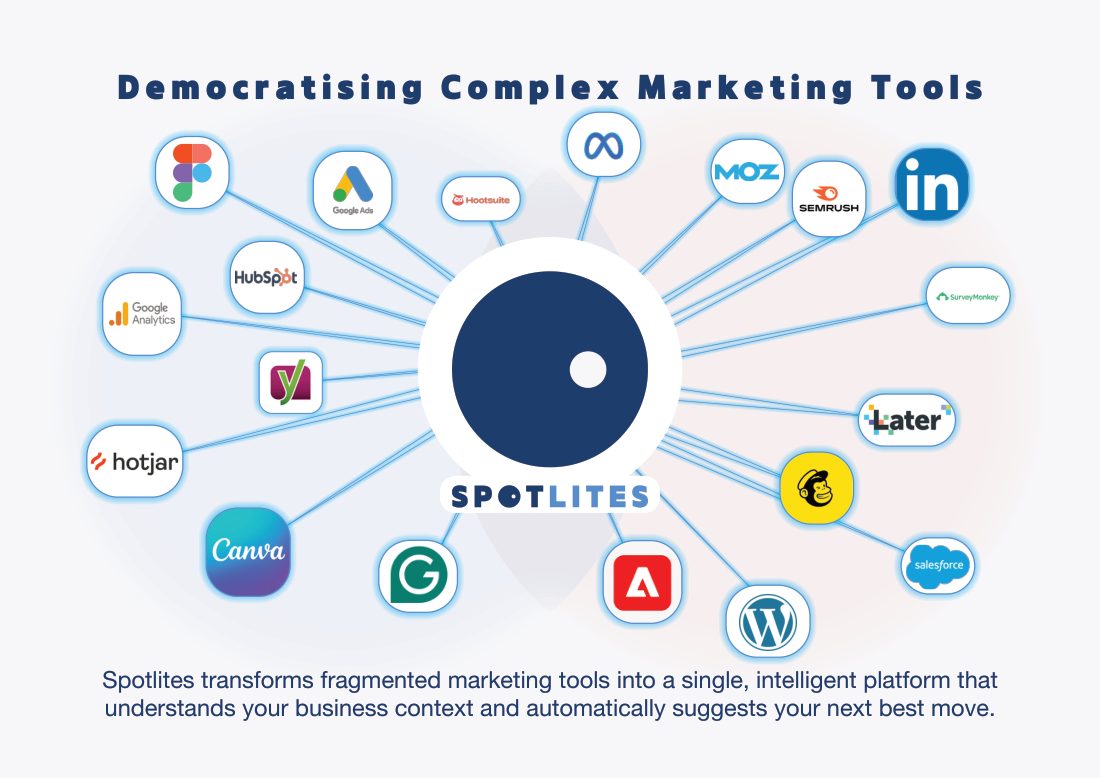
Spotlites is W'A.I's own product: designed, built and operated in-house, not commissioned. It combines both halves of the business: the marketing judgement about what actually moves a small company, and the engineering to deliver it at a price a small company can pay.
Spotlites 1.0, the market read
- Four fields and a URL. The whole input, on the principle that a tool asking a founder for information they do not have to hand will not be used twice
- Analysis via Google Gemini, with optional Companies House verification, an opt-in check that anchors the model's reading against the public register
- A structured report, not prose. Market insights, competitor comparisons, quick marketing wins, growth-stage assessment, and content ideas with a positioning line
- Sparky, the conversational front end. A branded, fully responsive HTML and JavaScript widget, Tailwind, jQuery and GPT-3.5-Turbo, no framework and no build step, that drops into a page
- A welcome screen that offers choices. Clickable suggestion chips, Brand positioning, Content strategy, so the first interaction is a decision rather than an empty box
- Session memory. Sparky infers business type, challenges and goals from the conversation, holds them, builds a personalised system prompt from them before each call, and asks a clarifying question when the context is too thin to answer well
Spotlites 2.0, the assessment engine
- A WordPress plugin exposing the assessment through a REST API and an admin interface, so it can be run by a person or called by a system
- Company verification first. The subject is resolved against the UK Companies House register before analysis, so the report attaches to a real registered entity
- Five fixed categories, financial, regulatory, supply chain, geopolitical and market, which is what makes two reports on two companies comparable
- Two model providers behind one interface, GPT-4 or Gemini, selected on availability, so a provider outage degrades the service rather than stopping it
- URL verification on the way out. Every cited source is checked to be real and live, the step that separates an evidence-backed report from a confident one
- The bridge into multifi. The same registry-check-in-front, source-check-behind pattern, applied where the subject is a company seeking finance
Opening with suggestion chips rather than a text field is the smallest decision here and the one that decides whether the product gets used. A blank prompt asks a founder to know what to ask an AI marketing strategist. Two chips tell them what it is for.
Committing to a growth-stage assessment is the most opinionated part of 1.0. It places a business somewhere concrete, which is more useful and more falsifiable than a paragraph of balanced observations, and a tool that can be wrong is a tool that can be right.
2.0 is the same product with the checks moved to both ends. A registry lookup before the model runs and a source check after it are what let the output be argued with rather than simply read, and that is the difference between a marketing tool and something a finance team will accept.
SYS.03 Spotlites 1.0, the market read
- Four fields and a URL. The whole input, on the principle that a tool asking a founder for information they do not have to hand will not be used twice
- Analysis via Google Gemini, with optional Companies House verification, an opt-in check that anchors the model's reading against the public register
- A structured report, not prose. Market insights, competitor comparisons, quick marketing wins, growth-stage assessment, and content ideas with a positioning line
- Sparky, the conversational front end. A branded, fully responsive HTML and JavaScript widget, Tailwind, jQuery and GPT-3.5-Turbo, no framework and no build step, that drops into a page
- A welcome screen that offers choices. Clickable suggestion chips, Brand positioning, Content strategy, so the first interaction is a decision rather than an empty box
- Session memory. Sparky infers business type, challenges and goals from the conversation, holds them, builds a personalised system prompt from them before each call, and asks a clarifying question when the context is too thin to answer well
SYS.04 Spotlites 2.0, the assessment engine
- A WordPress plugin exposing the assessment through a REST API and an admin interface, so it can be run by a person or called by a system
- Company verification first. The subject is resolved against the UK Companies House register before analysis, so the report attaches to a real registered entity
- Five fixed categories, financial, regulatory, supply chain, geopolitical and market, which is what makes two reports on two companies comparable
- Two model providers behind one interface, GPT-4 or Gemini, selected on availability, so a provider outage degrades the service rather than stopping it
- URL verification on the way out. Every cited source is checked to be real and live, the step that separates an evidence-backed report from a confident one
- The bridge into multifi. The same registry-check-in-front, source-check-behind pattern, applied where the subject is a company seeking finance
SYS.05 Creative response
SYS.06 The work

Ask for what they already know
A tool that needs information a founder has to go and find will not be opened twice.
If this looks close to something you are dealing with, the quickest route is to say so in a sentence. You will get a real reply from a person, usually with a first read on the problem rather than a calendar link.