
SYS.01 Objective
Economic security is abstract until it happens to you. Sanctions regimes, supply chain shocks and dual-use export controls are hard to brief and harder to make anyone feel.
The people who most need to understand them, bankers, trade financiers, policy staff, are also the hardest audience to hold with a presentation. A simulation asks them to decide instead of listen.
SYS.02 Creative response
Built and run as a W'A.I product, carrying forward a thread that began at Coriolis. Game design, platform build, the risk API behind it, and live facilitation.
- The Atlas Economic Risk API. A WordPress plugin taken through four versions to v1.0.3, exposing three REST endpoints under a namespace, country risk analysis, country data and a key health check
- Multi-model by design. Separate OpenAI and Google Gemini keys, each independently switchable, so the platform was never locked to one provider
- A structured risk model. Economic, political and financial categories, with GDP growth, inflation, debt-to-GDP, unemployment, current account and reserves, each carrying a direction of travel
- The game itself. A multi-level browser platform with prototypes in Adobe XD, built through to Level Three
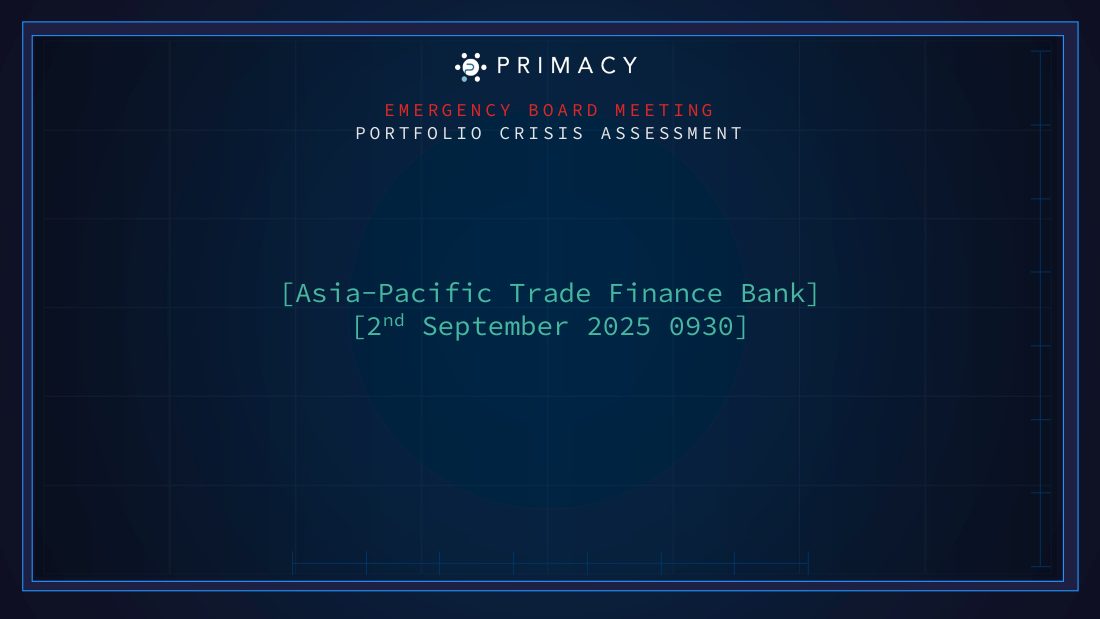
- TXF Dealmakers Assembly, 22 November 2023. A full facilitation kit: storyboard, briefing notes, three deck versions plus a reusable template, printed voting cards, a QR code and Slido live polling
- The GTR workshop. An Economic Threat Dashboard Simulation taken through three revisions
- Designed to fail gracefully. A deterministic offline path and a static country list, plus a facilitator's Connection Lost script, built for a conference room, not a demo environment
- Structured JSON, not free text. The risk assessment returns JSON a widget can render, which is what let the same engine drive the game board and a shortcode dropped into any page
- Live country metadata pulled from external sources, with fallback caching so an assessment still returns when an upstream API is slow or down
On the economic indicators
The indicators the assessment reports, GDP growth, inflation, unemployment and the rest, are calculated from simulated values, not live feeds. That is the single most important fact about this build and it belongs on the page rather than in a footnote.
For a simulation played in a conference room it is the right call: the game needs internally consistent numbers that behave plausibly under player decisions, and it needs them to arrive instantly on venue wifi. It would be the wrong call for anything sold as country intelligence, which is why the engine that does that job, the CES Monitor, corroborates against official records before anything counts.
SYS.03 Creative response
- The Atlas Economic Risk API. A WordPress plugin taken through four versions to v1.0.3, exposing three REST endpoints under a namespace, country risk analysis, country data and a key health check
- Multi-model by design. Separate OpenAI and Google Gemini keys, each independently switchable, so the platform was never locked to one provider
- A structured risk model. Economic, political and financial categories, with GDP growth, inflation, debt-to-GDP, unemployment, current account and reserves, each carrying a direction of travel
- The game itself. A multi-level browser platform with prototypes in Adobe XD, built through to Level Three
- TXF Dealmakers Assembly, 22 November 2023. A full facilitation kit: storyboard, briefing notes, three deck versions plus a reusable template, printed voting cards, a QR code and Slido live polling
- The GTR workshop. An Economic Threat Dashboard Simulation taken through three revisions
- Designed to fail gracefully. A deterministic offline path and a static country list, plus a facilitator's Connection Lost script, built for a conference room, not a demo environment
- Structured JSON, not free text. The risk assessment returns JSON a widget can render, which is what let the same engine drive the game board and a shortcode dropped into any page
- Live country metadata pulled from external sources, with fallback caching so an assessment still returns when an upstream API is slow or down
SYS.04 On the economic indicators
SYS.05 Results
Delivered live at the TXF Dealmakers Assembly in November 2023 and in the GTR workshop programme, with a feedback folder retained from the TXF run.
The live simulation also included a scripted offline fallback, allowing the experience to continue if the venue connection failed.
SYS.06 Watch
SYS.07 The work


Make them decide, not listen
A simulation with a contingency script has been run in a real room.
If this looks close to something you are dealing with, the quickest route is to say so in a sentence. You will get a real reply from a person, usually with a first read on the problem rather than a calendar link.